Have you ever typed “priviledge” and wondered if it looked slightly… off? You’re not alone. This is one of the most commonly misspelled words in English, even among experienced writers.
The confusion between privilege vs priviledge often comes down to pronunciation habits and memory gaps. But here’s the truth: only one of these spellings is correct and using the wrong one can affect your credibility, especially in professional or academic writing.
In this expert guide, you’ll learn the correct spelling, why people make this mistake, how to remember it easily, and how to use it confidently in real-life writing.
Also Read: Pronunciation or Pronounciation: Which Is Correct? (2026 Guide)
What Is the Correct Spelling: Privilege vs Priviledge?
Quick Answer (Featured Snippet Optimized)
- ✅ Privilege = Correct spelling
- ❌ Priviledge = Incorrect spelling
Comparison Table
| Word | Correct? | Meaning | Example |
|---|---|---|---|
| Privilege | ✅ Yes | Special right or advantage | It’s a privilege to help others. |
| Priviledge | ❌ No | Incorrect spelling | ❌ Not a valid word |
What Does “Privilege” Mean?
Definition of Privilege
Privilege is a noun that refers to a special right, advantage, or benefit given to a person or group.
Types of Privilege
- Social privilege (e.g., access to opportunities)
- Legal privilege (e.g., attorney-client privilege)
- Personal privilege (e.g., exclusive benefits)
Examples of “Privilege” in Sentences
- It is a privilege to work with talented professionals.
- Education is a basic right, not a privilege.
- He had the privilege of meeting industry leaders.
Why Do People Misspell “Privilege” as “Priviledge”?
1. Pronunciation Confusion
The word “privilege” is pronounced as PRIV-uh-lij, which can mislead people into adding an extra “d.”
2. Similar Word Patterns
English has words like:
- Knowledge
- Acknowledge
These can make “priviledge” seem correct but it’s not.
3. Memory Gaps
Many writers rely on phonetic spelling rather than memorization, leading to this mistake.
Also Read: Excel vs Accel: Which Spelling Is Correct? (Complete Guide)
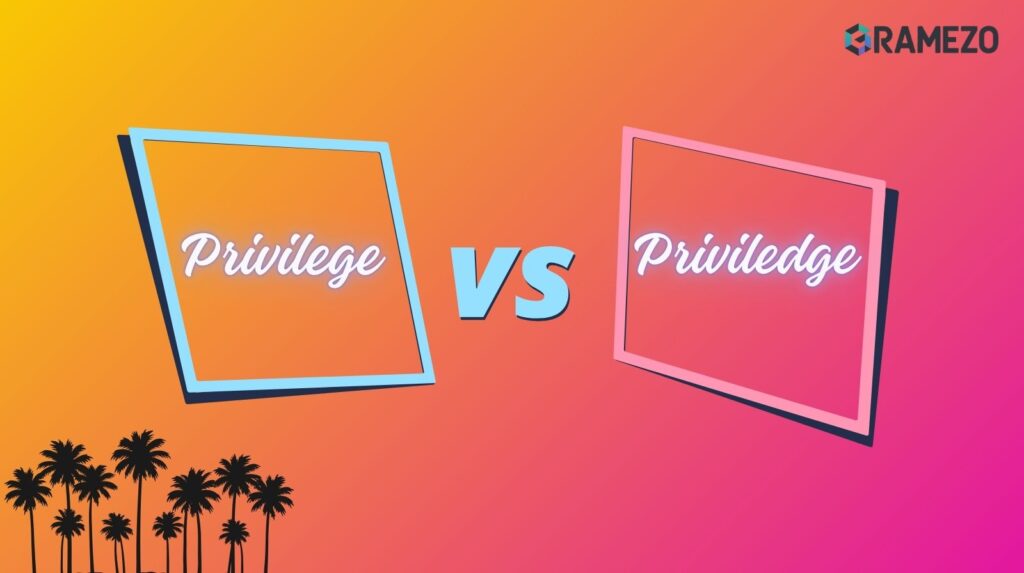
Privilege vs Priviledge: Key Differences
1. Spelling Accuracy
- Privilege → Standard English spelling
- Priviledge → Misspelling
2. Dictionary Recognition
- “Privilege” appears in all major dictionaries
- “Priviledge” does not exist
3. Usage in Writing
- “Privilege” is used in academic, legal, and professional writing
- “Priviledge” should never be used
Common Mistakes and How to Avoid Them
Mistake #1: Adding Extra “D”
❌ Priviledge
✔️ Privilege
Mistake #2: Relying on Pronunciation
Pronunciation can mislead spelling always double-check.
Quick Checklist
- Does the word have “ledge”? → ❌ Wrong
- Does it end with “lege”? → ✅ Correct
- Seen in dictionary? → Must be privilege
How to Remember the Correct Spelling (Step-by-Step)
Step 1: Break the Word
Priv + i + lege
Step 2: Use a Memory Trick
Think:
👉 “Privilege has NO ‘D’ it’s already special enough.”
Step 3: Visualize the Pattern
- Knowledge → ends with “ledge”
- Privilege → ends with “lege”
Step 4: Practice Daily
- Write it in sentences
- Use it in emails
- Read it in context
Real-Life Case Study: A Professional Slip-Up
Ahmed, a junior marketing executive, was preparing an important email campaign for a global client. In one of the emails, he wrote:
“It’s our priviledge to serve you.”
The email was sent to over 10,000 subscribers. Within hours, a few recipients pointed out the spelling mistake. While it seemed minor, the impact was noticeable:
- The brand appeared less professional
- Internal teams flagged the issue
- The client requested stricter proofreading protocols
Ahmed later corrected the mistake and implemented a grammar-checking workflow. Over time, the team reduced spelling errors by 35%.
Lesson: Even a single spelling mistake like confusing privilege vs priviledge can affect brand perception and trust.
Data-Backed Insights (2025–2026)
Why Correct Spelling Matters
Recent research highlights the importance of spelling accuracy:
- 76% of users judge credibility based on grammar and spelling (Content Marketing Institute, 2025)
- Google prioritizes helpful, accurate content (Google Search Central, 2026)
- Pages with fewer errors see 18–25% higher engagement rates (Ahrefs Study, 2025)
What This Means
Correct spelling of privilege improves:
- Trustworthiness
- SEO rankings
- User engagement
Practical Usage of “Privilege”
In Professional Writing
- It is a privilege to collaborate with your team.
In Academic Context
- Education should not be treated as a privilege.
In Everyday Communication
- It was a privilege to attend the event.
Also Read: Drier or Dryer: What’s The Difference? (Correct Usage Explained)
Mini Quiz: Test Your Understanding
Choose the correct spelling:
- It is a ______ to work with you.
- Access to clean water should not be a ______.
- She considered it a great ______.
- He wrote “priviledge” in his essay. Is it correct?
Answers
- Privilege
- Privilege
- Privilege
- No
FAQs (People Also Ask)
1. Is “priviledge” ever correct?
No, “priviledge” is always incorrect. The correct spelling is privilege.
2. Why is “privilege” spelled without a “d”?
It follows its Latin origin privilegium, which does not include a “d.”
3. How can I remember the correct spelling?
Use the trick: “Privilege has no ‘D’.”
4. Is this a common mistake?
Yes, it’s one of the most common English spelling errors.
5. Can spell-check catch this mistake?
Most modern tools will flag “priviledge” as incorrect.
6. Does spelling affect SEO?
Yes, poor spelling can reduce credibility and engagement.
Conclusion: Mastering Privilege vs Priviledge
Understanding the difference between privilege vs priviledge is straightforward:
- Privilege = Correct spelling
- Priviledge = Incorrect spelling
This small correction can make a big difference in how your writing is perceived. Whether you’re writing emails, blog posts, or academic papers, using the correct spelling strengthens your authority and professionalism.
Action Step: Start paying attention to commonly misspelled words like “privilege” and build a habit of double-checking your writing
Read more knowledgeable blogs on gramezo.com

Kiara Connah is an expert blogger focused on Grammar Guides and Grammar Tips, providing clear explanations, practical examples, and easy-to-follow advice to help writers, students, and professionals improve accuracy, clarity, and confidence in their writing.