
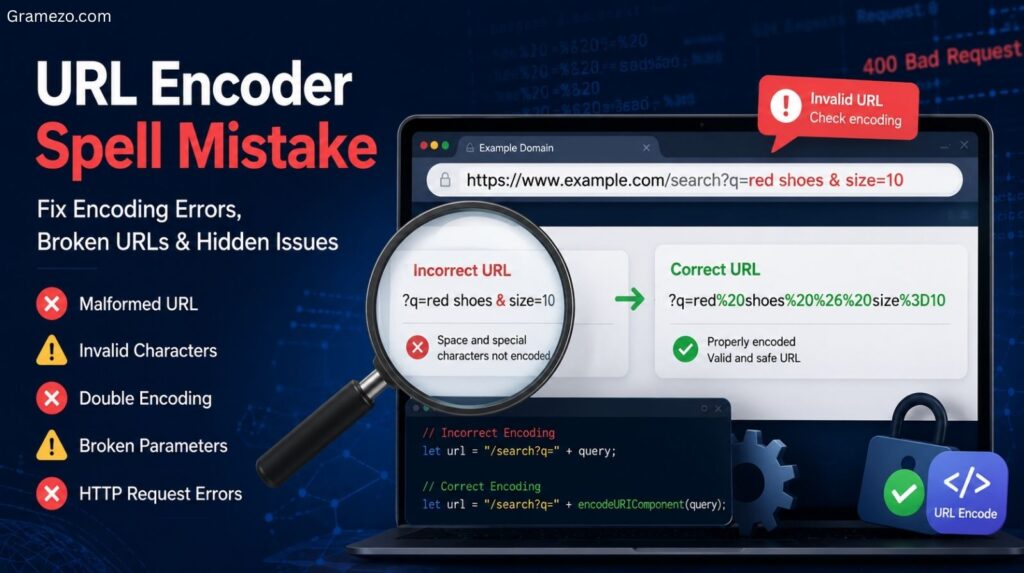
If you’ve ever clicked a link that just “refused to work” or watched an API request fall apart for no obvious reason, there’s a good chance a URL encoding issue was quietly causing chaos behind the scenes.
These problems don’t always scream for attention. Instead, they hide inside query parameters, percent encoding, UTF-8 conversions, and backend routing logic, slowly breaking things in ways that feel almost random.
And here’s the real frustration: most developers don’t notice a URL encoder spell mistake until it has already damaged SEO performance, broken an API endpoint, or corrupted user data.
Let’s fix that.
This guide breaks everything down in a simple, human way. You’ll understand what actually goes wrong, why it happens, and how to fix it without guesswork.
What a URL Encoder Spell Mistake Really Means (And Why It’s Misleading)
The term URL encoder spell mistake isn’t an official technical concept. It’s more like a shorthand people use when something goes wrong with URL encoding or URL decoding.
In reality, the problem usually comes from one of these situations:
- A URL gets encoded incorrectly
- A URL gets decoded too early or too late
- A system encodes the same data twice
- A backend and frontend disagree on formatting rules
So instead of a “spelling mistake,” you’re really dealing with a breakdown in how systems handle URL structure and transport-safe encoding.
Think of it like writing a message in code. If one person encrypts it twice and another decrypts it once, the final message turns into noise.
That’s exactly what happens with URLs.
How URL Encoding Actually Works (Without the Confusion)
Let’s simplify it.
A URL can only safely contain a limited set of characters defined by RFC 3986. Anything outside that set must be converted into a safe format using percent-encoding.
For example:
- Space →
%20 &→%26#→%23
So when you search for:
best shoes for men
It becomes:
best%20shoes%20for%20men
This transformation is called percent encoding, and it ensures your request survives across browsers, servers, and networks without corruption.
Under the hood, here’s what really happens:
- Text is converted into UTF-8 bytes
- Each byte is translated into hex characters
- Each hex value is prefixed with
%
That’s it. Simple in concept, tricky in execution.
And this is where most URL encoding issues begin.
URL Encoding vs URL Decoding: The Silent Mismatch Problem
Encoding and decoding should work like a handshake.
- Frontend encodes data before sending it
- Backend decodes it after receiving it
But in real systems, things rarely stay that clean.
A URL decoding error often appears when:
- The backend decodes something that was already decoded
- The frontend forgets to encode something at all
- A proxy layer modifies the URL unexpectedly
For example:
%2520
This is a classic double encoding problem.
Here’s what happened:
- First encoding: space →
%20 - Second encoding:
%becomes%25 - Final result:
%2520
Instead of a space, the system sees garbage.
That’s how a simple mismatch becomes a production bug.
Why URL Encoding Matters More Than Most Developers Think
At first glance, encoding feels like a small detail. But in real systems, it sits right in the middle of everything:
- HTTP requests
- API endpoints
- backend routing
- SEO indexing
- authentication flows
One small mistake can break all of them.
A single malformed URL can:
- Return a 400 Bad Request error
- Break redirect chains
- Corrupt tracking parameters
- Confuse search engine crawlers
And once search engines like Googlebot encounter inconsistent URLs, they may start indexing duplicates or ignoring pages entirely.
That’s where SEO damage from URL encoding errors becomes very real.
Common Causes of URL Encoder Spell Mistakes
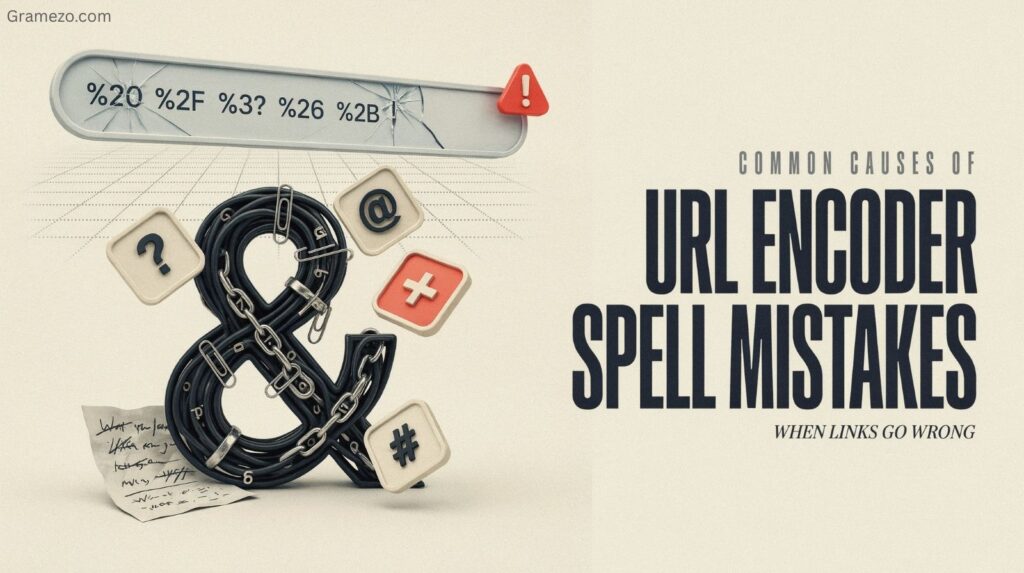
Most encoding problems don’t come from complex logic. They come from simple human habits.
1. Manual URL construction
Building URLs like this is risky:
"/search?q=" + query
If query contains special characters, things break fast.
2. Inconsistent encoding layers
Sometimes both frontend and backend encode the same value.
That leads to recursive encoding issues.
3. Misinterpreted reserved characters
Characters like:
&?=
are not just text. They have meaning inside URLs.
Misusing them can completely reshape a request.
4. UTF-8 handling problems
When systems don’t fully support UTF-8 encoding, you may see:
- Broken characters
- Garbled strings
- Invalid hex sequences
5. Proxy and CDN interference
Tools like CDN edge caching, load balancers, and WAF (Web Application Firewall) layers can rewrite URLs silently.
That makes debugging even harder.
Real Examples of URL Encoding Failures (And How They Break Systems)
Let’s look at real-world cases that happen in production environments.
Spaces Inside Search Queries
/search?q=hello world
This should be:
/search?q=hello%20world
If not encoded properly, the server may treat “world” as a separate parameter.
Ampersands Breaking Query Strings
/search?q=phones&sort=price
If q contains &, the system splits it into multiple parameters.
Result: broken logic.
Broken UTF-8 Characters
Example:
café
If encoding fails, you may see:
café
This usually comes from mismatched ASCII conversion and UTF-8 decoding.
Recursive Double Encoding
%2520 instead of %20
This is one of the most painful bugs because it often goes unnoticed until it hits production.
Why APIs and Backend Systems Break So Easily
Modern systems rely on strict interpretation rules.
When a request hits an API endpoint, it passes through:
- API gateway
- routing middleware
- backend server
- service layer logic
Each layer may decode or re-encode data differently.
That’s where problems like:
- routing failures
- authentication redirect issues
- payload corruption
start appearing.
In distributed systems and microservices architectures, even a tiny mismatch can cascade into multiple failures.
Frontend vs Backend Encoding Conflicts
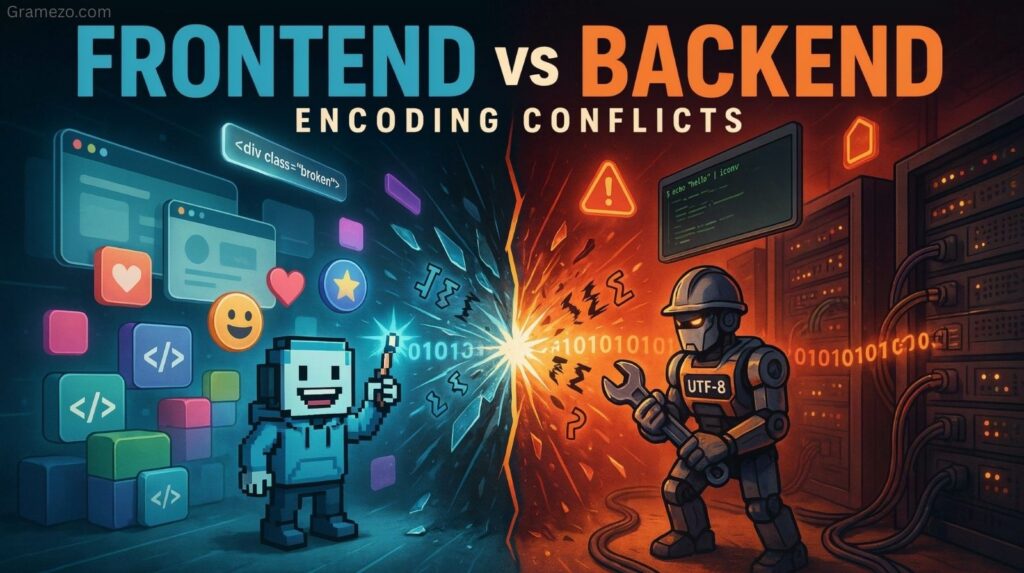
This is one of the most common real-world issues.
Frontend tools like JavaScript often use:
encodeURIComponent()
But backend systems might use:
urlencode()urllib.parse.quoteURLEncoder.encode
The problem?
They don’t always behave the same way.
So when frontend encodes something and backend encodes it again, you get mismatched outputs.
That’s how frontend backend encoding mismatch becomes a real production issue.
SEO Impact of URL Encoding Mistakes (The Hidden Damage)
This part is often ignored, but it matters a lot.
Search engines rely on clean, consistent URLs for indexing.
When encoding fails, you get:
Duplicate indexing issues
Same page appears under multiple encoded versions.
Crawl budget waste
Search engine crawlers waste time crawling broken or duplicate URLs.
Canonical URL problems
Google struggles to identify the correct version.
Broken internal linking structure
Links point to inconsistent versions of the same resource.
Over time, this leads to technical SEO degradation and lost visibility.
How to Detect URL Encoding Problems in Real Systems
You don’t need guesswork. You need visibility.
Here’s how developers usually debug it:
Browser tools
Chrome Developer Tools → Network tab
Check raw request vs decoded request.
API testing tools
Tools like Postman help validate encoded URLs before deployment.
Server logs
Look for:
- malformed URL structure
- invalid characters
- repeated encoding patterns
Monitoring systems
Platforms like Datadog or Sentry help catch encoding-related failures early.
Why Manual URL Construction Is Dangerous
Manually building URLs feels fast. But it introduces hidden risk.
You might forget:
- encoding special characters
- handling edge cases
- escaping reserved symbols
A better approach is to always rely on built-in functions that handle encoding automatically.
It removes human error from the equation.
Advanced Troubleshooting for Persistent Encoding Errors
Some bugs refuse to go away easily.
When that happens:
- Compare raw vs decoded request values
- Trace full request lifecycle
- Inspect proxy behavior (CDN, WAF, load balancer)
- Test edge cases like emojis and special characters
- Validate UTF-8 consistency across services
This is where differential analysis becomes useful comparing expected vs actual encoding behavior step by step.
Best Practices to Prevent URL Encoding Issues
A few habits can eliminate most problems:
- Encode once, at the correct layer
- Never manually build query strings
- Normalize UTF-8 everywhere
- Validate input before sending requests
- Standardize encoding rules across teams
Simple discipline prevents complex failures.
Secure Development and URL Encoding
Encoding is not just about stability. It’s also about security.
Proper encoding helps prevent:
- injection attacks
- URL manipulation
- session hijacking via query strings
Think of encoding as part of your input sanitization pipeline, not just a formatting step.
Long-Term Strategy for Stable URL Architecture
If you’re building scalable systems, consistency matters more than clever tricks.
Strong systems:
- define encoding rules clearly
- document URL structure standards
- enforce validation at API level
- test encoding in CI pipelines
- monitor URL health continuously
This prevents silent failures from spreading across services.
Final Thoughts: Why URL Encoding Mistakes Break Everything Quietly
A URL encoding issue rarely announces itself loudly.
It doesn’t crash your system immediately.
Instead, it slowly:
- breaks APIs
- corrupts analytics
- damages SEO performance
- confuses routing systems
And by the time you notice, the impact has already spread.
That’s why understanding percent encoding, UTF-8 behavior, RFC 3986 rules, and backend decoding logic isn’t optional anymore.
It’s part of building reliable modern web systems.
Because in the end, a URL isn’t just a string.
It’s a contract between systems.
And when that contract breaks, everything built on top of it starts to wobble.
Discover More Articles
- Xendit Gamification Summit Work: Inside The Workplace Gamification Revolution That Redefined Employee Engagement
- Exploring goralblue com: A Rising Content Platform Shaping Travel, Lifestyle, And SEO Writing
- What Is Team Aelftech com? A Deep, Practical Look At This Modern Digital Marketing Company And What It Actually Does
Read more knowledgeable blogs on meezvo.com

Kiara Connah is an expert blogger focused on Grammar Guides and Grammar Tips, providing clear explanations, practical examples, and easy-to-follow advice to help writers, students, and professionals improve accuracy, clarity, and confidence in their writing.