
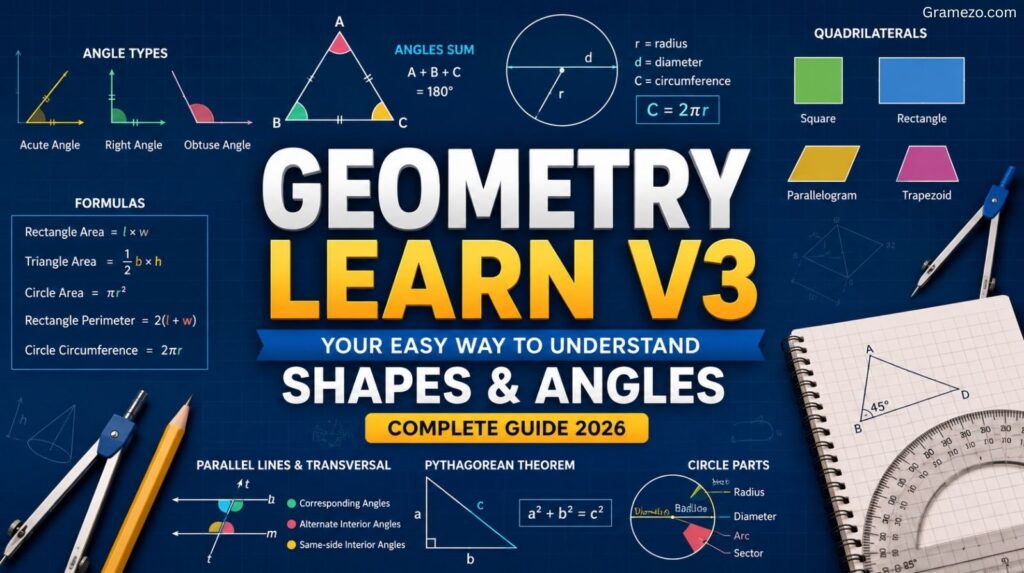
Geometry can feel like a maze when you first meet it. Too many rules. Too many shapes. Too many diagrams that look like secret codes.
But here’s the truth most learners miss: geometry isn’t complicated. It’s visual logic.
Once you see the patterns, everything clicks.
This guide to Geometry Learn V3 breaks geometry down in a way that actually feels human. You won’t just memorize formulas. You’ll understand why they exist, how they connect, and where you see them in real life.
From basic geometry concepts like points and lines to advanced ideas like transformations and coordinate geometry, this is your complete map.
Let’s start from the ground up.
What Is Geometry? Understanding Geometry Learn V3 as a Visual Language
Geometry is the branch of Mathematics that studies shapes, sizes, positions, and space. But that definition barely scratches the surface.
Think of geometry as the “language of space.” It explains how everything fits together, from the screen in your hand to the buildings around you.
With Geometry Learn V3, the goal is simple: turn abstract rules into visual understanding.
Instead of memorizing, you start seeing patterns:
- Lines behave in predictable ways
- Angles follow relationships
- Shapes connect through structure
- Space follows logic
That’s where spatial reasoning skills begin to grow.
Geometry is not just schoolwork. It’s how engineers design bridges, how animators build digital worlds, and how GPS systems guide your route.
Once you understand geometry, you start reading the world differently.
The Foundation of Geometry: Basic Geometry Concepts You Must Know
Before shapes and angles, you need the building blocks.
These elements form everything else in geometry fundamentals 2026.
Point
A Point has no size. No width. No length. It only marks a position.
Think of it like a dot on a map. It tells you “this is where something exists.”
Line
A Line stretches endlessly in both directions.
It has no start and no end. Just pure direction.
Line Segment
A Line Segment has two endpoints.
Unlike a line, it has a fixed length. You can measure it.
Ray
A Ray starts at one point and extends forever in one direction.
Think of sunlight coming from a flashlight.
Plane
A Plane is a flat surface that extends infinitely.
Like a sheet of paper that never ends.
Why These Basics Matter
Without these, geometry becomes confusing fast. Every shape, angle, and structure builds from them.
That’s why Geometry Learn V3 focuses heavily on points lines rays explanation early on.
Once you understand these, everything else becomes easier to visualize.
Understanding Shapes and Angles in Geometry Learn V3
Shapes are just combinations of lines and curves. Angles appear where those lines meet.
This is where geometry starts feeling real.
What Is an Angle?
An Angle forms when two rays share a common endpoint called a vertex.
Angles tell us how open or closed something is.
They are measured in degrees using a Protractor.
Angle Measurement Basics
Angles follow a Degree Scale:
- 0° means no opening
- 90° is a right turn
- 180° is a straight line
- 360° is a full rotation
Learning angle measurement basics is like learning speed limits in geometry. Everything depends on it.
Types of Angles You’ll See Everywhere
- Acute Angle (less than 90°)
- Right Angle (exactly 90°)
- Obtuse Angle (between 90° and 180°)
- Straight Angle (180°)
- Reflex Angle (more than 180°)
Look around your room. You’ll spot all of them in furniture, doors, and screens.
That’s real life geometry examples in action.
Angle Relationships: The Hidden Logic Behind Geometry
Angles don’t exist alone. They interact.
This is where angle relationships become powerful.
Complementary Angles
Two angles that add up to 90°.
They often appear in corners of shapes and right triangles.
Supplementary Angles
Two angles that add up to 180°.
Think of a straight road turning back.
Vertical Angles
Opposite angles formed when lines cross. They are always equal.
This is one of those rules that feels like magic at first.
Adjacent Angles
Angles that share a side and a vertex.
Simple, but important for solving diagrams.
Once you understand these relationships, solving geometry problems becomes less guessing and more logic.
Parallel Lines and Transversals: The Pattern Machine of Geometry
Parallel lines never meet. But when a third line crosses them, things get interesting.
That third line is called a Transversal.
It creates patterns:
- Corresponding Angles
- Alternate Interior Angles
- Alternate Exterior Angles
- Same-Side Interior Angles
These patterns repeat like music beats.
Once you recognize them, solving angle problems becomes much faster.
This is a core part of parallel line angles in geometry learning v3.
Understanding Polygon Shapes and Classification
A Polygon is a closed shape made of straight lines.
Simple idea. Powerful structure.
Common Polygons
- Triangle (3 sides)
- Quadrilateral (4 sides)
- Pentagon (5 sides)
- Hexagon (6 sides)
- Octagon (8 sides)
Regular vs Irregular Polygons
- Regular Polygon: all sides and angles equal
- Irregular Polygon: sides or angles differ
This is where polygon classification becomes important for design, engineering, and mapping systems.
Triangles: The Most Important Shape in Geometry
If geometry had a backbone, it would be the triangle.
Why? Because triangles are stable.
They don’t collapse like other shapes.
Types of Triangles by Sides
- Equilateral Triangle: all sides equal
- Isosceles Triangle: two sides equal
- Scalene Triangle: all sides different
Types of Triangles by Angles
- Right Triangle: one 90° angle
- Acute Triangle: all angles less than 90°
- Obtuse Triangle: one angle greater than 90°
Triangle Angle Rule
All interior angles always add up to 180°.
This is one of the most important triangle properties in geometry.
It’s not a trick. It’s structure.
Why Triangles Matter in Real Life
You’ll see triangles in:
- Bridges
- Roof designs
- Engineering supports
- Game physics
- Animation structures
That’s triangle stability in action.
Quadrilateral Shapes and Their Properties
A Quadrilateral has four sides.
But each type behaves differently.
Key Shapes
- Square: equal sides and angles
- Rectangle: opposite sides equal
- Parallelogram: slanted opposite sides
- Rhombus: equal sides, tilted shape
- Trapezoid: one pair of parallel sides
These shapes form the backbone of architecture and design systems.
Understanding quadrilateral properties helps you break complex figures into simpler parts.
Circle Properties: The Most Perfect Shape in Geometry
A Circle is defined by points that stay equal distance from a center.
Simple idea. Deep structure.
Key Terms
- Radius: center to edge
- Diameter: across the circle
- Circumference: boundary length
- Arc: part of the curve
- Sector: slice of a circle
Circles appear everywhere in GPS systems, wheels, clocks, and digital design.
They represent balance and motion.
Perimeter and Area: Measuring Space in Geometry
Measurement turns shapes into numbers.
Perimeter
Total distance around a shape.
Area
Space inside a shape.
This is where perimeter and area become practical.
You use them in:
- Construction
- Farming
- Interior design
- Mapping
A common mistake? Mixing units.
Always check whether you’re working in square units or linear units.
Spatial Awareness and Symmetry in Geometry
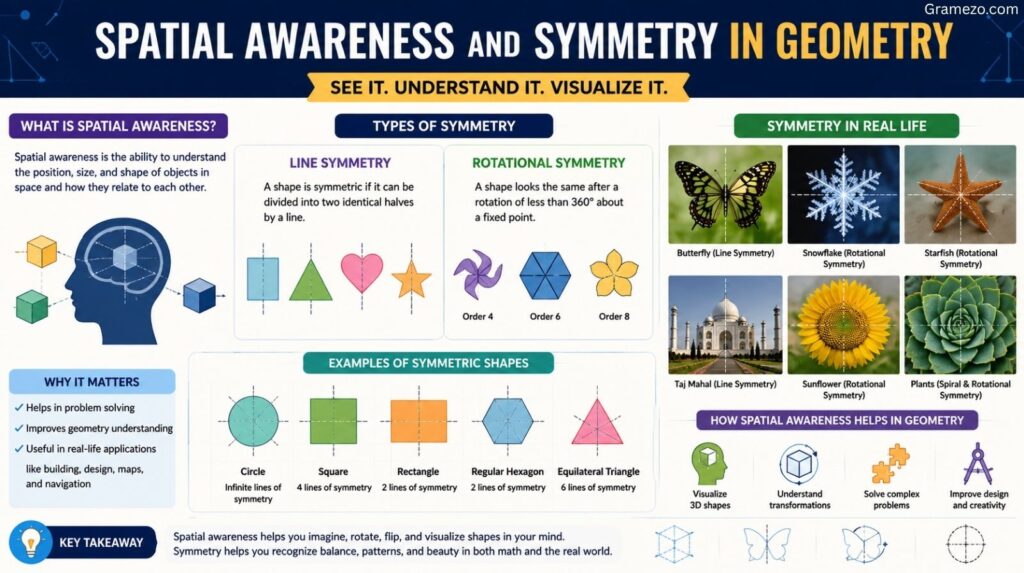
Geometry trains your brain to see structure.
Symmetry
A shape is symmetrical when both sides match.
Rotational Symmetry
A shape looks the same after turning.
Think of snowflakes or wheels.
These patterns appear in snowflakes, sunflower patterns, and even spider webs.
That’s geometry in nature revealing hidden order.
Congruent and Similar Shapes Explained
Congruent Shapes
Same shape, same size.
Similar Shapes
Same shape, different size.
This is critical in scale drawings used in maps, blueprints, and engineering.
Geometric Transformations: Moving Shapes Without Breaking Them
Shapes can move without changing identity.
- Translation (sliding)
- Rotation (turning)
- Reflection (flipping)
- Dilation (resizing)
These are core ideas in geometric transformations used in animation and computer graphics geometry.
Every video game you play uses these principles.
Coordinate Geometry: Mapping Shapes on a Grid
Coordinate geometry puts shapes on a system.
You use:
- X-axis
- Y-axis
It helps in:
- Navigation systems
- GPS systems
- Digital design geometry
You can calculate distance, position, and movement.
This turns geometry into a map of logic.
Geometry in Nature: Patterns That Repeat Everywhere
Nature loves geometry.
You see it in:
- Snowflakes
- Sunflower spirals
- Tree rings
- Spirals in shells
- Molecular structures
These aren’t random. They follow mathematical rules.
That’s geometric patterns in the real world.
Real-World Geometry Applications
Geometry powers modern life.
- Architecture builds structures
- Engineering designs stability
- Animation creates motion
- Mapping guides travel
- Sports analyze angles
- Design shapes visual identity
Without geometry, modern systems collapse.
That’s how important it is.
Geometry Learn V3 Study Strategy
If you want to improve fast, don’t just read.
Do this instead:
- Draw shapes daily
- Practice angle measurement
- Break problems into steps
- Use visual thinking
- Repeat patterns until they stick
Consistency beats intensity.
That’s how geometry problem solving actually improves.
Common Geometry Mistakes
Most learners struggle because of small errors:
- Misreading angles
- Confusing similar shapes
- Forgetting units
- Assuming diagrams are accurate
- Skipping steps
Fix these early and everything becomes easier.
Final Thoughts: Why Geometry Learn V3 Works
Geometry isn’t about memorizing rules.
It’s about recognizing patterns in space.
Once you train your eyes, geometry stops feeling like math homework. It starts feeling like decoding the world.
And honestly, that’s where it gets fun.
From basic geometry concepts to real-life geometry applications, everything connects.
You just need to see it once.
Discover More Articles
- Tubefalire Explained: The Real Causes Behind Digital Failures And How To Prevent System Breakdown In Modern Workflows
- Do Cadillac Lyriq Driving Modes Change Range Or Battery Usage? Complete 2026 Guide To Real-World EV Efficiency
- URL Encoder Spell Mistake: The Complete Guide To Fixing Encoding Errors, Broken URLs, And Hidden System Failures
- Coolkingzone com: Why This Multi-Topic Digital Platform Is Quietly Dominating Online Attention
Read more knowledgeable blogs on meezvo.com

Kiara Connah is an expert blogger focused on Grammar Guides and Grammar Tips, providing clear explanations, practical examples, and easy-to-follow advice to help writers, students, and professionals improve accuracy, clarity, and confidence in their writing.